
Last updated: September 2026
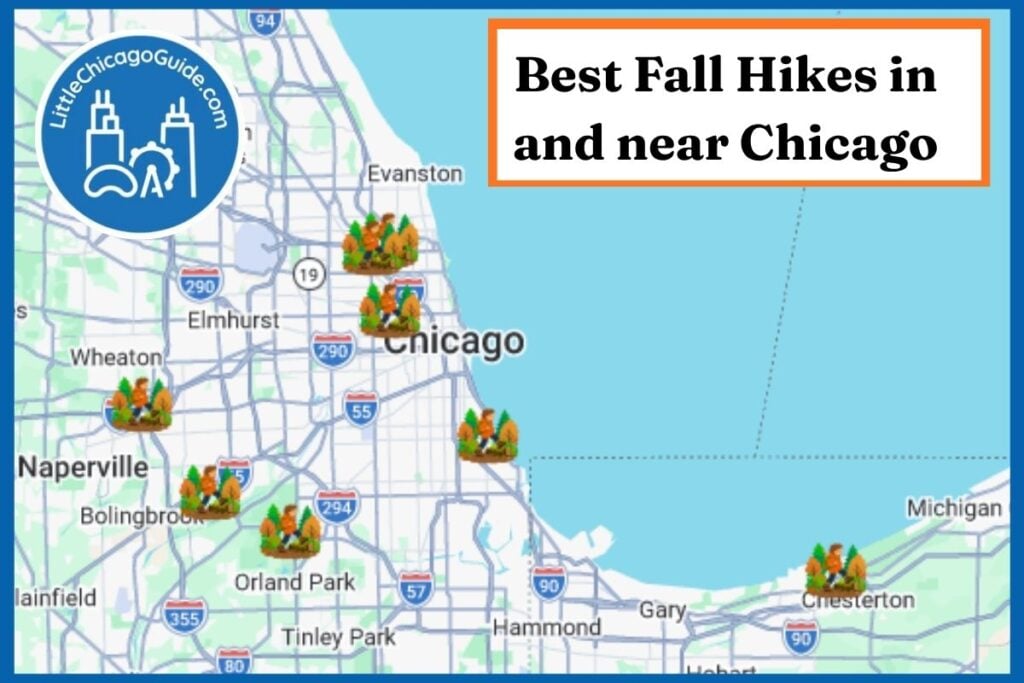
The best fall hikes near Chicago aren’t the ones with the most miles. They’re the ones you can actually reach on the weekend you’re free, in the two-week window when the color is worth the trip. Some are inside the city limits and free. A few are worth the drive.
I’ve had a place in Chicago part-time for about ten years, and the thing nobody tells visitors is that the city itself turns late and mildly. The good woods are twenty to forty-five minutes out, and half of them are free to walk into. Below are eight places sorted by how far you have to go, with the transit or the parking, the dog rules, and what the trail actually is underfoot.

In a Nutshell
- Best without a car: North Park Village Nature Center on the Northwest Side, open daily 9 a.m. to 4 p.m. and free.
- Best long hike: Waterfall Glen in Darien, with almost 11 miles of mapped limestone and turf trails.
- Best workout: the limestone stairs up the 100-foot bluff at Swallow Cliff Woods in Palos Park.
- Best with a dog: any Cook County forest preserve, where leashed dogs are allowed on trails that aren’t on the district’s prohibited list.
- Best by train: Cowles Bog at Indiana Dunes National Park, reachable on the South Shore Line.
- Timing: plan for the middle two weeks of October. Forecasts disagree by about a fortnight, so watch the trackers rather than booking a date in August.
- Cost: six of the eight below are free. Only the Morton Arboretum and the national park charge.
Two things shape every hike on this list. The first is that Chicagoland is flat, so “hilly” here means a ravine, a bluff, or an old glacial moraine, and those are exactly where the color reads best because you can see down into a canopy instead of standing under it.
The second is light. Oaks and hickories dominate the woods here, and they turn later and browner than the maples everyone pictures. If you want the postcard version, look for maple stands and anything near water, where the reflected light does half the work.
Quick Picks by Interest
- No car: North Park Village Nature Center, Jackson Park’s Wooded Island, or the 606.
- Young kids: North Park Village, where the loop is short, flat and signposted.
- Stroller or wheelchair: the 606, paved end to end with ramp access at every park entrance.
- With a dog: Waterfall Glen, where leashes must be under 10 feet, or any unrestricted Cook County preserve.
- Half a day and a real hike: Waterfall Glen or the Palos preserves.
- Color plus water: Cowles Bog at Indiana Dunes, which ends at a quiet Lake Michigan beach.
Fall Hikes Inside the City
You don’t need a car to walk in the woods here, and this is the part most fall roundups skip entirely. These three are free, reachable on transit, and none of them takes a full day.
North Park Village Nature Center, North Park
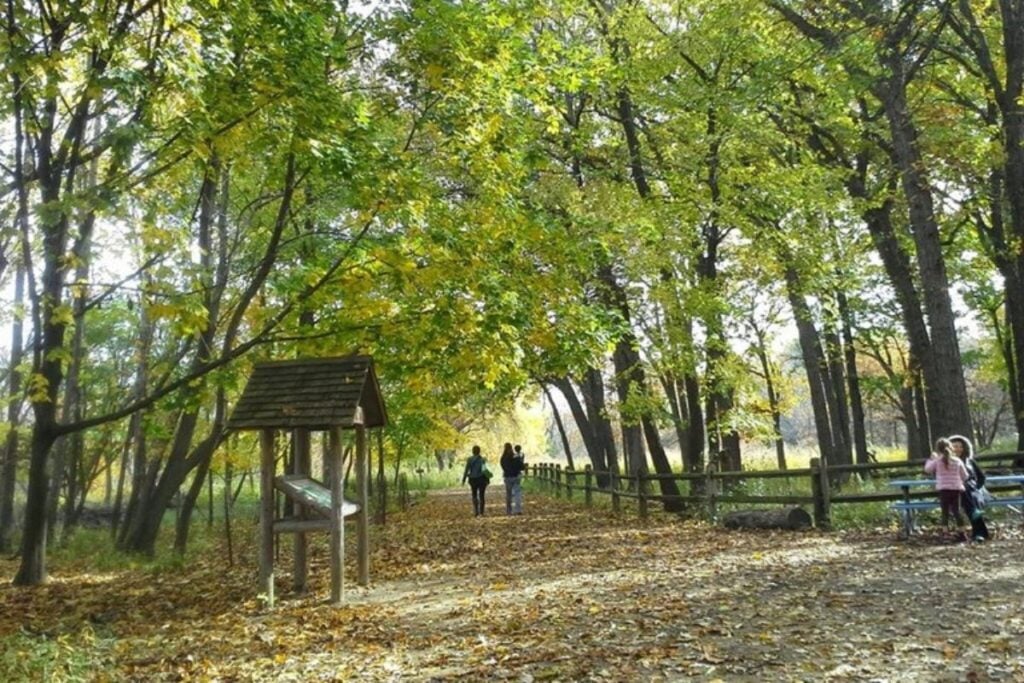
This is the one I’d send you to first if you’re without a car and want something that actually feels like a forest. It’s a nature preserve of about 46 acres on the Northwest Side, inside the old North Park Village campus, with trails looping through woodland, wetland, prairie and oak savanna. The maples along the wooded stretch are the reason to come in October.
It’s run by the Chicago Park District, it’s free, and it’s open daily from 9 a.m. to 4 p.m. Those hours matter more than they sound: this isn’t a sunrise-to-sunset preserve, so an after-work walk in late October doesn’t work.
- Address: 5801 N. Pulaski Rd., Chicago, IL 60646
- Hours: daily, 9 a.m. to 4 p.m.
- Cost: free
- Getting there: the 53 Pulaski bus runs past the campus entrance at Ardmore. There’s no L stop close enough to walk.
- Accessibility: the Park District lists the nature center facility as accessible
- More information: Chicago Park District
Wooded Island, Jackson Park, Hyde Park
Come here if you want a walk with some history attached. Wooded Island sits in the lagoons of Jackson Park on the South Side, the park Frederick Law Olmsted laid out for the 1893 World’s Columbian Exposition, and it’s one of the best birding spots in the city during fall migration. The loop is flat, roughly a mile, and quiet in a way the lakefront never is.
Take the Metra Electric from Millennium Station to 55th–56th–57th Street and walk east. It’s faster and considerably more pleasant than the bus, and it drops you close enough to make this a two-hour outing rather than an expedition. Pair it with the rest of Hyde Park and you’ve got a full day on the South Side.
The 606, Logan Square to Humboldt Park
Not a hike in the boots-and-trail-mix sense, but it’s the right answer for anyone pushing a stroller or using a wheelchair, and it’s genuinely pretty in October. The elevated trail runs about 2.7 miles along an old rail line through Wicker Park, Bucktown, Logan Square and Humboldt Park, planted deliberately enough that the color arrives on schedule.
It’s paved end to end with ramp access at the park entrances along the route. Blue Line to Damen or Western puts you within a few blocks of the eastern half. Full details are in my guide to the 606.
Pro tip: Cook County forest preserves open at sunrise and close at sunset, every gate, every day. In late October sunset lands before 6 p.m., so a 4:30 start is a short walk, not an evening one. Check the Forest Preserves’ interactive map for gates and parking before you leave.
Fall Hikes Within an Hour of Chicago
This is where the real hiking is, and all four of these are a straightforward drive from the city. Three of them are free.
Waterfall Glen, Darien
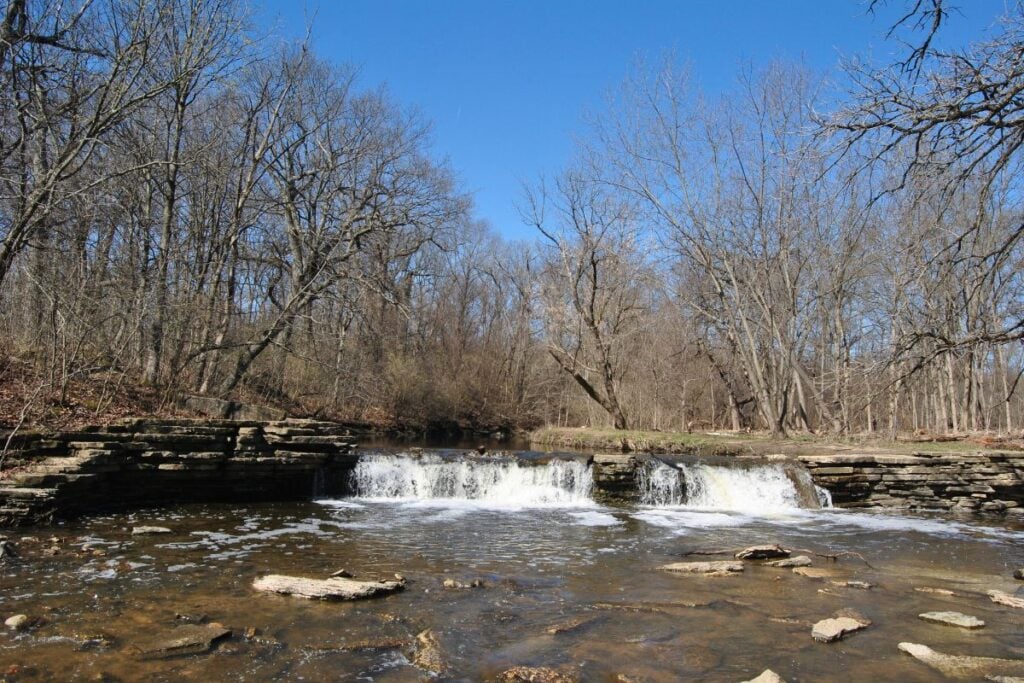
If you only do one hike on this list, make it this one. Waterfall Glen wraps around Argonne National Laboratory in DuPage County and it has the closest thing to varied terrain within an hour of Chicago: ravines, bluffs above Sawmill Creek, oak savanna, and the small tiered cascade at Rocky Glen that gives the preserve its name.
The district maps four trails totaling almost 11 miles of limestone and turf, and the main loop circles the whole preserve. You do not have to do the whole loop. Park at the Bluff Road lot and the waterfall is a short walk in, which is the version to take if you’ve got kids or a couple of hours.
- Where: main entrance on Northgate Road, 0.25 mile west of Cass Avenue, Darien. The waterfall lot is on Bluff Road, 0.3 mile east of Cass Avenue.
- Hours: one hour after sunrise to one hour after sunset
- Cost: free
- Dogs: allowed, on leashes under 10 feet
- Surface: crushed limestone and turf, so a standard stroller is a struggle
- More information: Forest Preserve District of DuPage County
Swallow Cliff Woods and the Palos Preserves, Palos Park
Swallow Cliff is for the person who wants to feel it in their legs. A limestone staircase climbs a 100-foot bluff where a toboggan slide used to run, and a second set of stairs added later turns it into a circuit. People treat it as an outdoor gym, so expect company and don’t expect quiet.
The reason to come anyway is what’s behind it. Swallow Cliff sits at the edge of the Palos and Sag Valley preserves, the largest stretch of unpaved trail in Cook County, with ravines and sloughs that hold color well. Walk away from the stairs and the crowd disappears within ten minutes. There’s no realistic transit option here, so this one’s a drive, roughly 45 minutes from the Loop without traffic.
LaBagh Woods, Northwest Side
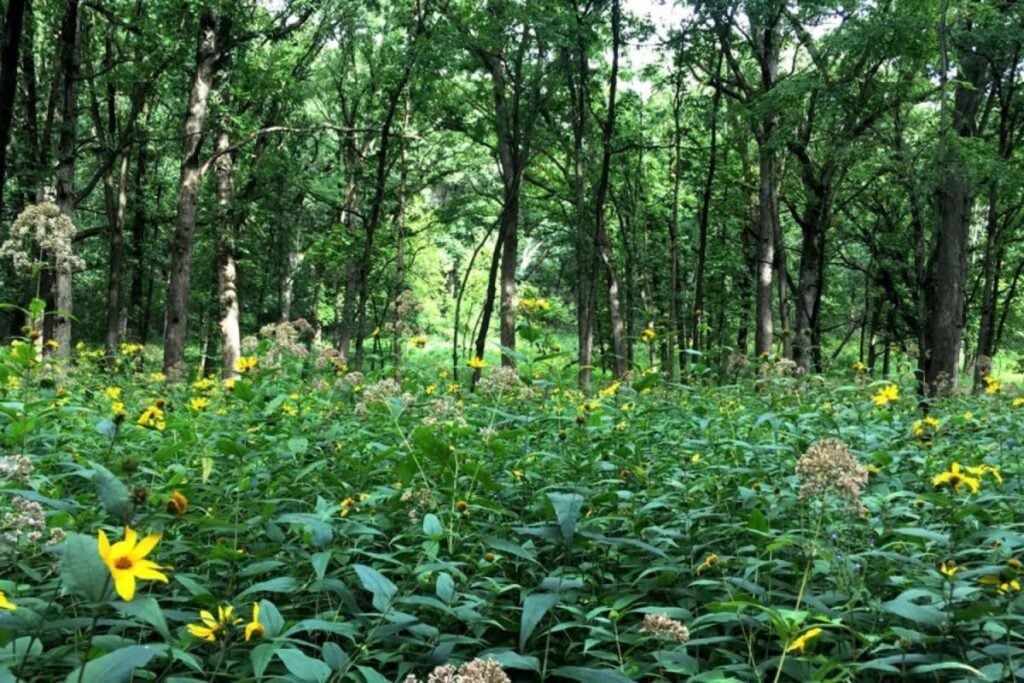
LaBagh is a Cook County forest preserve inside the city limits, along the North Branch of the Chicago River near Foster and Cicero, and it’s one of the better urban birding spots in Chicago during migration. The trails are unpaved and informal, the river does the work visually, and you’re in a genuine bottomland forest ten minutes from an expressway.
It’s free, open sunrise to sunset, and leashed dogs are welcome like at most Cook County preserves. Driving is the practical way in; there’s parking off Cicero Avenue.
The Morton Arboretum, Lisle
This is the one to pay for, and the only place on this list where the trees were chosen rather than inherited. The Arboretum runs 1,700 acres in Lisle with a large network of trails, and because the collection includes species from all over the world, the color lasts longer and runs wider than a native Illinois woodland does.
The grounds are open daily from 9 a.m. to sunset, with last entry an hour before sunset. Admission is timed and the price moves with demand, so buy online ahead rather than at the gate, where it costs more. October weekends sell out. Here’s what I’d do: go on a weekday if you possibly can, and walk the east side trails rather than driving the loop road, which is what most visitors do and which is the reason the road feels busy while the trails don’t.
- Where: 4100 IL-53, Lisle, IL 60532
- Hours: grounds open 9 a.m. to sunset daily, last entry one hour before sunset
- Cost: timed general admission, priced by date and $2 cheaper online than at the gatehouse
- Getting there: Metra BNSF to Lisle, then a taxi or rideshare. It’s not a walkable distance from the station.
- Tickets and hours: The Morton Arboretum
Pro tip: Buy Morton Arboretum tickets the week before, not the morning of. Admission is priced by date and the further ahead you buy online, the less you pay, which is the opposite of how most attractions work.
The Hike Worth Leaving the State For
Cowles Bog Trail, Indiana Dunes National Park
An hour east of the city, and the only hike here that ends at a Lake Michigan beach you’ll likely have to yourself in October. The Cowles Bog Trail runs through ponds, marshes, swamps and black oak savanna before climbing a steep sand dune to the shoreline, and the plant diversity along it was enough to earn the area National Natural Landmark status in 1965.
It is not an easy walk. Loose sand on the dune climb makes the last stretch harder than the distance suggests, and there’s no water on the trail. The payoff is that almost nobody does this one while the crowds head for the swimming beaches.
This is also the best fall hike near Chicago you can reach by train. The South Shore Line runs from Millennium Station to Dune Park and Beverly Shores, which makes a car-free day genuinely workable. Leashed dogs are allowed in most of the park, and fees vary by area, so check both before you go: the park publishes its current fees and its pet policy. Trail details are on the park’s Cowles Bog page.
When Fall Color Peaks Near Chicago
Plan for the middle two weeks of October and stay flexible. Forecasts for the Chicago area regularly disagree by about two weeks, which is the single fact most people are trying to plan around, so treat any guide that gives you one confident date with suspicion.
What moves it: cold nights and sunny days speed color up, a warm cloudy stretch delays it, and a dry summer drops leaves early with less color. Anything within an hour of the city runs later than the woods up north, which is genuinely useful when you’ve missed your window elsewhere. I track the regional version weekly on Michigan peak fall colors, and the timing logic there applies to northern Illinois too.
Hiking With a Dog Near Chicago
Most of the forest preserve land around Chicago is dog-friendly on a leash, which makes it a better bet than city parks or the lakefront. The Forest Preserves of Cook County allow leashed dogs at any location or trail not on the district’s prohibited list, and mark approved locations on their maps. Off-leash is limited to three membership-only dog areas, and nowhere else.
In DuPage County, Waterfall Glen allows dogs on leashes under 10 feet. At Indiana Dunes, leashed dogs are allowed in most areas with some exceptions. Full Cook County rules are on the Forest Preserves dog page.
What to Bring and What to Skip
Layers you can carry, and shoes you don’t mind getting muddy. October here swings between 70 degrees and 45 in the same week, and trails along the Des Plaines and the North Branch hold water for days after rain.
What to skip: Busse Woods, if hiking is the point. It’s a paved multi-use loop with heavy bike traffic and expressway noise, which makes it a fine ride and a mediocre walk. And skip anything advertised as a fall hike inside the Loop. Downtown parks hold color late and look good, but they’re a walk, not a hike, and pretending otherwise wastes your best weekend.
If you’d rather make a weekend of it than a morning, the color gets dramatically better two to six hours out. My guide to fall road trips from Chicago covers ten drives with the week each one usually peaks, including Starved Rock, which is the closest thing to canyon hiking in Illinois.
The Chicago Weekly
Color moves week to week and so does everything else worth doing here. I send one email a week with where the leaves actually are, which trails are flooded, and what’s worth your Saturday, in time to do something about it. Come along for the season.
Fall Hikes Near Chicago: Questions and Answers
Where can I hike near Chicago without a car?
North Park Village Nature Center on the Northwest Side is reachable on the 53 Pulaski bus and free. Wooded Island in Jackson Park is a short walk from the Metra Electric stop at 55th–56th–57th Street. For a longer day, the South Shore Line runs to Dune Park and Beverly Shores for Indiana Dunes National Park.
What is the best fall hike near Chicago?
Waterfall Glen in Darien, for the variety. It has ravines, a creek bluff, oak savanna and a small waterfall across almost 11 miles of mapped trails, it’s free, and it’s about 40 minutes from downtown. Take the Bluff Road lot for the short version or the main loop for a half day.
Are the forest preserves free?
Yes. Cook County and DuPage County forest preserves are free to enter and free to park. The two places on this list that charge are the Morton Arboretum, which sells timed admission, and Indiana Dunes National Park, where fees vary by area.
When do the leaves change near Chicago?
The middle two weeks of October in most years, with forecasts varying by about two weeks. Woods close to the city run later than those to the north, so a trip that’s too late for Wisconsin or northern Michigan can still be right on time here.
Which fall hike is best with young kids?
North Park Village Nature Center. The loop is short and flat, the signage explains what you’re looking at, and the nature center itself gives you somewhere to go if the weather turns. For a waterfall payoff without the mileage, park at the Bluff Road lot at Waterfall Glen.
Can I hike with my dog?
On leash, yes, nearly everywhere on this list. Cook County allows leashed dogs on trails that aren’t on its prohibited list, Waterfall Glen requires leashes under 10 feet, and Indiana Dunes allows leashed dogs in most areas. The Morton Arboretum and the nature centers are the exceptions to check before you load the car.
Pick the weekend first and the trail second, and keep a city option in your back pocket for the Saturday it rains. If the hike turns into a whole day out, the pumpkin farms are in the same direction as half these preserves, and fall in Chicago covers what the city itself is doing while the leaves turn. Tell me which one you take, because I’m still deciding where I’m going this year.