
Last Updated: June 2026
Millennium Park is the best place to start a first trip to Chicago — free, right in the heart of the Loop, and packed into one square mile with the most photographed sculpture in the city, a Frank Gehry concert hall, a hidden rooftop botanical garden, and a winding pedestrian bridge that makes people stop and stare. I’ve brought dozens of first-time visitors here over the years and the reaction is always the same: they didn’t expect it to be this good.

This guide covers every major attraction, what’s worth your time, what most visitors miss, current 2026 event dates and closures, and a full-day itinerary — whether you’ve got two hours or the whole day. I’ve written about the city for Fox 32 Chicago, and Millennium Park is still the first place I point people. For a wider look at the city’s attractions, see our best things to do in Chicago guide.
In a Nutshell
- Cost & hours: Millennium Park is free, open daily 6am–11pm, at 201 E Randolph St in the Loop.
- Getting there: CTA to Washington/Wabash (Brown, Green, Orange, Pink, Purple) or Monroe/Lake (Red) — then walk east.
- Must-see: Cloud Gate (The Bean), Crown Fountain, Jay Pritzker Pavilion, and the Nichols Bridgeway to the Art Institute.
- Best photo time: Before 9am for The Bean without crowds; after dark for the city-lights reflection.
- Food: Millennium Hall — Napolita Pizzeria (year-round), plus Double Clutch Beer Garden and Casa Bonita (May–Oct).
- 2026 heads-up: Lurie Garden is closed March 2–early July 2026 for repairs to its boardwalk and water feature; the Pritzker Pavilion trellis is under renovation.
[SimpleTOC]
⚠️ 2026 Closures to Know Before You Visit
Lurie Garden is closed from March 2 through early July 2026 while crews repair the “Seam” boardwalk and its water feature. It’s one of the best spots in the park — plan to visit after it reopens in summer.
Jay Pritzker Pavilion trellis is under renovation. The Great Lawn is open for events, but expect some space closures and construction materials nearby. Check millenniumpark.org before your visit for the latest.
What to See in Millennium Park
Cloud Gate (The Bean)
Cloud Gate — universally known as “The Bean” — is a 110-ton polished stainless steel sculpture by British-Indian artist Anish Kapoor, and it’s the single most photographed thing in Chicago. The 66-foot-long, 33-foot-high sculpture reflects the skyline, the clouds, and everyone around it in a warped, funhouse-mirror way that never gets old. Walk underneath the 12-foot arch to the “omphalos” — the concave underside — where your reflection fractures into dozens of copies overhead. It’s disorienting in the best way, and most people don’t bother to go underneath.
Cloud Gate sits on Grainger Plaza, which was fully renovated with new porcelain pavers and reopened in June 2024 after a year of construction. It’s accessible from all sides. See our complete Chicago Bean guide for the best photo spots, timing tips, and everything else worth knowing before you go.
💡 Pro Tip: The Bean is mobbed from 10am to 5pm in summer. Come before 9am or after dark — the nighttime reflections of the city lights across the curved surface are a completely different experience and just as spectacular. The Bean is accessible during park hours, 6am–11pm daily.
Crown Fountain

Crown Fountain is two 50-foot glass-brick towers designed by Spanish artist Jaume Plensa, each displaying video faces of real Chicagoans — a rotating collection of about 1,000 portraits commissioned by the School of the Art Institute of Chicago. The faces cycle slowly and then “spit” a stream of water into the shallow reflecting pool below. In summer it becomes one of the best free splash pads in the city, and kids wade in without hesitation. In winter the towers still show the faces but the water shuts off.
The water runs from roughly mid-May through mid-October. If you’re visiting with kids in summer, bring a towel and a change of clothes — they will get soaked and won’t want to leave. Planning a spring break trip? Our spring break Chicago with kids guide maps out how to plan around Crown Fountain and Maggie Daley Park.
Jay Pritzker Pavilion & the Great Lawn

The Jay Pritzker Pavilion is Frank Gehry’s masterpiece — a bandshell with signature flowing stainless steel ribbons that curl outward over a 4,000-seat bowl and the Great Lawn behind it. An overhead trellis of steel pipes (currently under renovation) carries a sound system that delivers concert-hall acoustics to every seat on the lawn. It honestly sounds better from a blanket on the grass than many actual concert halls.
This is where Chicago’s major free summer programming happens. For 2026: the Millennium Park Summer Music Series (select Mondays and Thursdays, June 15–August 6), the Summer Film Series (Tuesdays, July 1–August 19, on a 40-foot LED screen), free Saturday morning workouts (yoga, Pilates, cardio kickboxing, May 17–August 30), the Grant Park Music Festival (free classical concerts, June 10–August 15), the Chicago Blues Festival (June 4–7), and the Chicago Jazz Festival (September 3–6). For the full summer calendar, see our Chicago summer festivals guide. Chairs and blankets are welcome on the Great Lawn, and you can bring your own food.
💡 Pro Tip: For summer concerts and movies, the seats in the Pritzker bowl are first come, first served; the Great Lawn is where you set up blankets and low chairs. Gates typically open 1–2 hours before events. Check millenniumpark.org for the schedule, and note the trellis renovation may affect some lawn areas.
Lurie Garden
⚠️ Closed March 2–early July 2026 for repairs to the boardwalk and water feature. Worth returning for later in your trip or on a future visit.
Lurie Garden is the park’s best-kept secret — a 2.5-acre botanical garden tucked into the southeast corner, enclosed by a 15-foot “shoulder hedge” that nods to Carl Sandburg’s description of Chicago as the “City of Big Shoulders.” The hedge grew so tall the garden became genuinely hidden from casual visitors, which is exactly how regulars liked it. Designed by landscape architects Gustafson Guthrie Nichol with plantings by Dutch designer Piet Oudolf (who later designed New York’s High Line), it’s built on top of a multi-level parking garage — one of the largest green roofs in the world.
The garden holds hundreds of plant varieties across two sections: the “Dark Plate” (shade-loving plants) and the “Light Plate” (sun-loving perennials and grasses), split by the “Seam,” a raised boardwalk over a shallow canal — the very feature being restored in 2026. Each season transforms it completely, from spring wildflowers to sculptural winter seedheads. Free volunteer-led tours run in summer once it reopens.
BP Pedestrian Bridge & Maggie Daley Park
The BP Pedestrian Bridge is another Frank Gehry design — a 925-foot winding footbridge clad in brushed stainless steel that snakes from the Great Lawn over Columbus Drive into Maggie Daley Park. The curved walls block traffic noise while framing the skyline and lake below. It takes about five minutes end to end, and the views from the midpoint are some of the best in the city.
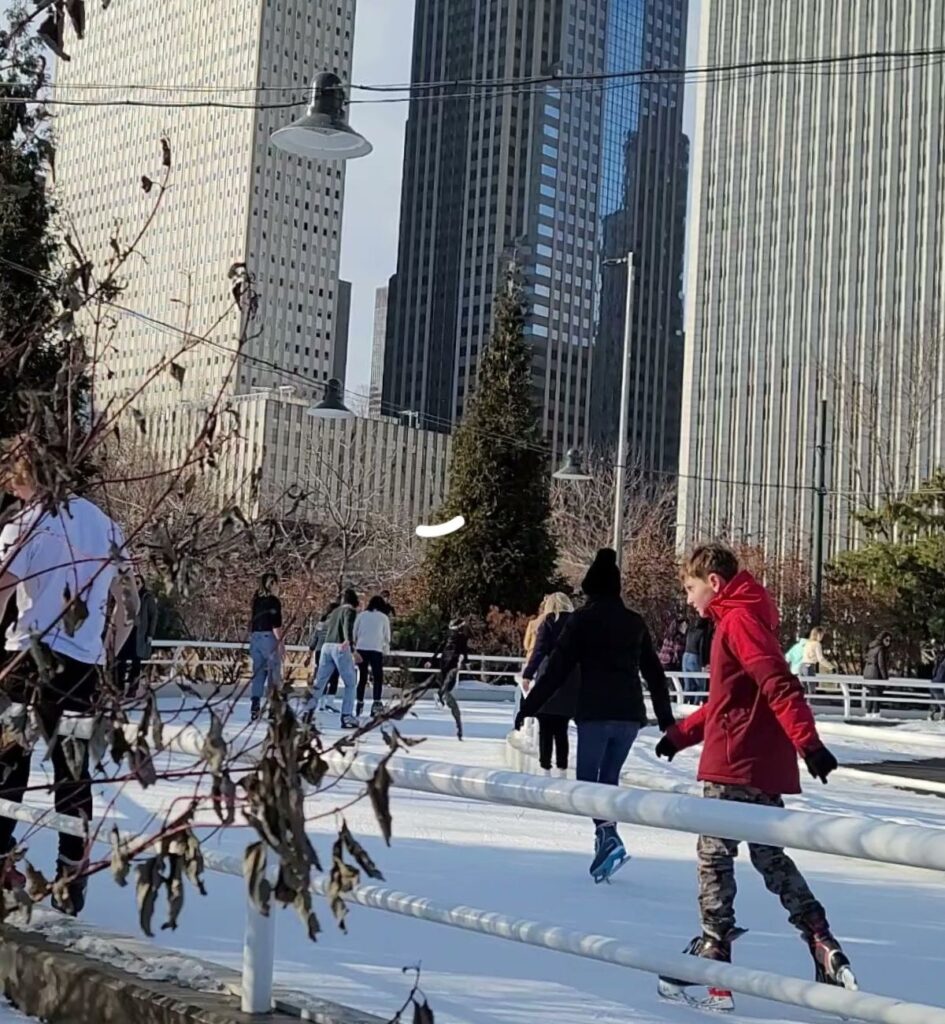
Maggie Daley Park on the other side is worth the detour — especially the Play Garden (a huge Alice in Wonderland–inspired playground with suspension bridges, tube slides, and a ship), the climbing wall, seasonal 18-hole mini golf, and the Skating Ribbon in winter, a winding ice path twice the length of a standard rink that runs mid-November through early March. Online reservations are recommended. Planning a full day with kids? Our Chicago with kids in winter guide maps it out.
McCormick Tribune Ice Rink
The McCormick Tribune Ice Rink opens each November directly in front of Cloud Gate and typically runs through early February. Admission is free — you pay only for skate rentals if you don’t bring your own. The rink draws over 100,000 skaters a year, and gliding past The Bean with the Michigan Avenue skyline overhead is one of Chicago’s most iconic winter experiences. Online reservations are required — book at millenniumpark.org. For more cold-weather ideas, see our best things to do in Chicago in winter.
Wrigley Square & the Millennium Monument
Wrigley Square sits at the northwest corner of the park at Michigan Avenue and Randolph Street, anchored by the Millennium Monument — a nearly full-size replica of the peristyle colonnade that stood here from 1917 to 1953. The Welcome Center is here, with free maps, event info, and restrooms, and it’s the best entry point from the CTA Washington/Wabash stop.
Boeing Galleries
The two Boeing Galleries (North and South) flank the Chase Promenade and host rotating free contemporary art exhibitions year-round — sculpture, installation, and mixed-media works. Easy to walk past, but worth a few minutes. Free walking tours of the park’s public art run on the first and third Saturday of each month, April through October, led by DCASE volunteers. Sign up at chicago.gov.
What’s Right Next to the Park
Art Institute of Chicago connects directly via the Nichols Bridgeway, a Renzo Piano–designed pedestrian bridge that drops you on the museum’s third-floor Modern Wing. One of the largest art museums in the US — Monet, Seurat, Hopper, Grant Wood’s American Gothic, and the Thorne Miniature Rooms. Plan 2–4 hours. Adults $25; Chicago residents and Illinois teens under 18 free. See my full Art Institute guide for what not to miss, and our guide to the best Chicago museums to plan more museum time.
Chicago Cultural Center sits directly across Michigan Avenue at 78 E Washington St. Free admission, always. The building is the attraction: the world’s largest Tiffany glass dome (38 feet across), rotating art exhibitions, and occasional free concerts. Worth 30 minutes.
Maggie Daley Park, across the BP Pedestrian Bridge, has a playground, climbing wall, seasonal mini golf, tennis courts, and the winter Skating Ribbon. Free to enter; some activities have fees. Navy Pier is a 15-minute walk north along the lakefront, with rides, the Centennial Wheel, restaurants, and the Chicago Children’s Museum.
Millennium Park is also surrounded by some of Chicago’s most remarkable architecture. For a deeper look at what’s around you, our guide to must-see Chicago landmarks covers the Loop and beyond, and the Loop hidden gems guide is worth a read before you explore the side streets.
Where to Eat at Millennium Park
Inside the park — Millennium Hall: the main dining complex sits on the plaza near Cloud Gate, with three concepts. Napolita Pizzeria serves wood-fired Neapolitan pizza year-round indoors; Double Clutch Beer Garden is Chicago’s largest outdoor beer garden (800-plus seats, craft beer and shareable plates, May–October); and Casa Bonita Cantina offers fresh Mexican food and margaritas (May–October). During summer concerts and movies, concession tents near Pritzker Pavilion sell food, beer, and wine.
Also in the park: Momentum Coffee sits directly under Cloud Gate in Millennium Hall — coffee, pastries, Chicago hot dogs, and smoothies. Worth knowing if you arrive early for Bean photos and need caffeine first.
Just outside the park: Michigan Avenue is one block west with restaurants at every price point. For a sit-down meal nearby, see my guide to restaurants near the Art Institute. Heading to brunch after a morning visit? Our best Chicago brunch spots has options close by, and our Chicago on a budget guide covers the best free and cheap options around the Loop. and out guide to restaurants near Grant Park will come in handy, too.
2026 Free Events at Millennium Park
| Event | 2026 Dates | Cost |
|---|---|---|
| Chicago Blues Festival | June 4–7 | Free |
| Grant Park Music Festival | June 10–Aug 15 (Wed/Fri/Sat evenings) | Free |
| Summer Music Series | Select Mon & Thu, June 15–Aug 6 | Free |
| Saturday Morning Workouts | Saturdays, May 17–Aug 30 | Free |
| Summer Film Series | Tuesdays, July 1–Aug 19 (6:30pm) | Free |
| Chicago Jazz Festival | Sept 3–6 | Free |
| McCormick Tribune Ice Rink | November–early February | Free admission (rentals extra) |
A Full Day at Millennium Park: Hour-by-Hour
This itinerary works any season — summer gives you the most programming, winter gives you the least crowded park. Adjust around the 2026 closures noted above.
Morning (8:30am–12pm)

Start at Cloud Gate before 9am — your window for clean photos before the crowds. Walk underneath the arch, look up at the omphalos, and take your time. Then head south through the Chase Promenade and check the Boeing Galleries for the current exhibition. If Lurie Garden has reopened (expected early July 2026), the southeast corner is at its most beautiful in morning light.
Walk back north to Wrigley Square for the Welcome Center and restrooms. On a summer Saturday (May 17–August 30), the free workout series runs on the Great Lawn in the morning. In winter, the McCormick Tribune Ice Rink is your morning highlight. Done by mid-morning? Our best Chicago brunch spots has great options nearby in the Loop.
Lunch (12pm–1:30pm)
Head to Millennium Hall. In warm weather, grab a table at Double Clutch Beer Garden overlooking the plaza; in cooler months, eat indoors at Napolita Pizzeria. On a budget? Pack a picnic for the Great Lawn. For more sit-down options nearby, see my guide to restaurants near the Art Institute.
Afternoon (1:30pm–5pm)
Cross the Nichols Bridgeway into the Art Institute of Chicago for 2–3 hours. The bridge deposits you in the Modern Wing on the third floor — start there, then work through the Impressionist collection and the Thorne Miniature Rooms. See our full Art Institute guide for what not to skip. With kids who won’t last a full museum visit, cross the BP Pedestrian Bridge to Maggie Daley Park instead — the Play Garden is one of the best kids’ playgrounds in the city.
In summer, Crown Fountain is where to be between 1pm and 4pm — the splash pad is at peak energy and kids are completely in their element. Bring a towel.
Evening (5pm–9pm)

In summer this is when the park comes alive. The Grant Park Music Festival (classical, free, Wed/Fri/Sat evenings, June 10–August 15), the Summer Music Series (select Mondays and Thursdays, June 15–August 6), and the Summer Film Series (Tuesdays, 6:30pm, July 1–August 19) all take place at Pritzker Pavilion. Bring a blanket for the Great Lawn, grab food from the concession tents, and settle in.
If there’s no event, walk back to Cloud Gate after dark — the nighttime skyline reflections are worth seeing twice. End with a stroll down Michigan Avenue or head to the Chicago Riverwalk a few blocks north. Want a show? The best Chicago comedy clubs — including Second City — are a short walk away.
💡 Pro Tip: Millennium Park is Day 1 of our 3-Day Chicago Itinerary for first-time visitors. If this is your first trip, that guide maps the park alongside the Art Institute, the Riverwalk, an architecture boat tour, and more — all in logical order.
Getting There & Practical Info
- 📍 Address: 201 E Randolph St, Chicago, IL 60601 — millenniumpark.org
- ⏰ Hours: Daily 6am–11pm. Welcome Center 9am–7pm (later during events). Hours can change — confirm before you go.
- 💰 Admission: Free, always
- 📞 Phone: 312-742-1168
- 🚇 CTA L train: Washington/Wabash (Brown, Green, Orange, Pink, Purple) one block east; or Monroe/Lake (Red) or Washington (Blue), walk east. See our full CTA guide.
- 🚆 Metra: Millennium Station (underground at Randolph St) connects directly to the park
- 🅿️ Parking: Millennium Park Garage, 5 S Columbus Dr (prepay online for best rates); Grant Park North, 25 N Michigan Ave; Grant Park South, 325 S Michigan Ave
- ♿ Accessibility: Fully accessible — ramped entrances; wheelchairs and assistive listening devices at the Patron Service Tent during events; ASL interpretation at Pritzker Pavilion concerts
- 🐕 Dogs: Not permitted in Millennium Park (service animals welcome)
- 👤 Youth policy: Guests under 18 must be accompanied by an adult (21+) after 6pm on weekend evenings; ID may be requested. Days enforced have varied — confirm current rules at millenniumpark.org before an evening visit.
- 🏨 Where to stay: Our downtown Chicago hotels guide covers the Loop and River North at every budget
However long you’ve got, Millennium Park rewards an early start: come before 9am for The Bean, work your way south through the art and gardens, cross into the Art Institute or Maggie Daley Park in the afternoon, and stay for a free concert on the Great Lawn if it’s summer. It’s free, it’s central, and it’s still the easiest “wow” in Chicago.
Yes — Millennium Park is completely free and open daily 6am–11pm. Cloud Gate, Crown Fountain, Jay Pritzker Pavilion, and the BP Pedestrian Bridge are all free. The only costs are food, parking, bike rentals, and skate rentals at the ice rink.
Take the CTA L to Washington/Wabash (Brown, Green, Orange, Pink, Purple Lines) and walk one block east. From the Red Line, exit at Monroe or Lake. Metra trains stop at Millennium Station underground at Randolph Street, connecting directly to the park.
No — Lurie Garden is closed March 2 through early July 2026 for repairs to its boardwalk (“the Seam”) and water feature. Check millenniumpark.org for reopening updates before your visit.
Millennium Hall near Cloud Gate has Napolita Pizzeria (wood-fired pizza, year-round), Double Clutch Beer Garden (Chicago’s largest outdoor beer garden, May–October), and Casa Bonita Cantina (Mexican, May–October). Momentum Coffee is directly under The Bean.
Summer (June–September) has the most free programming; winter brings free ice skating at the McCormick Tribune Rink. For The Bean without crowds, arrive before 9am or come after dark for the city-lights reflection.
The Art Institute connects via the Nichols Bridgeway; Maggie Daley Park is across the BP Bridge; the Chicago Cultural Center (free Tiffany dome) is across Michigan Avenue; the Riverwalk and Navy Pier are short walks north.
Keep Planning Your Chicago Trip
- 3-Day Chicago Itinerary for First-Time Visitors — Millennium Park is Day 1
- Complete Guide to the Chicago Bean (Cloud Gate) — best times, photo tips, and insider details
- Guide to the Art Institute of Chicago — connected via the Nichols Bridgeway
- Loop Hidden Gems — the best tucked-away spots around the park
- First-Time Visitor’s Guide to Chicago — the complete trip-planning overview
- Chicago CTA Guide — how to navigate the L like a local